
Hot water rebates · South Australia 2026
If your hot water system packs it in over the next few months, the help you can get toward a new one starts with two dates and one question: is your home on mains gas? The exact help also depends on the system you choose, your home and the offers available.
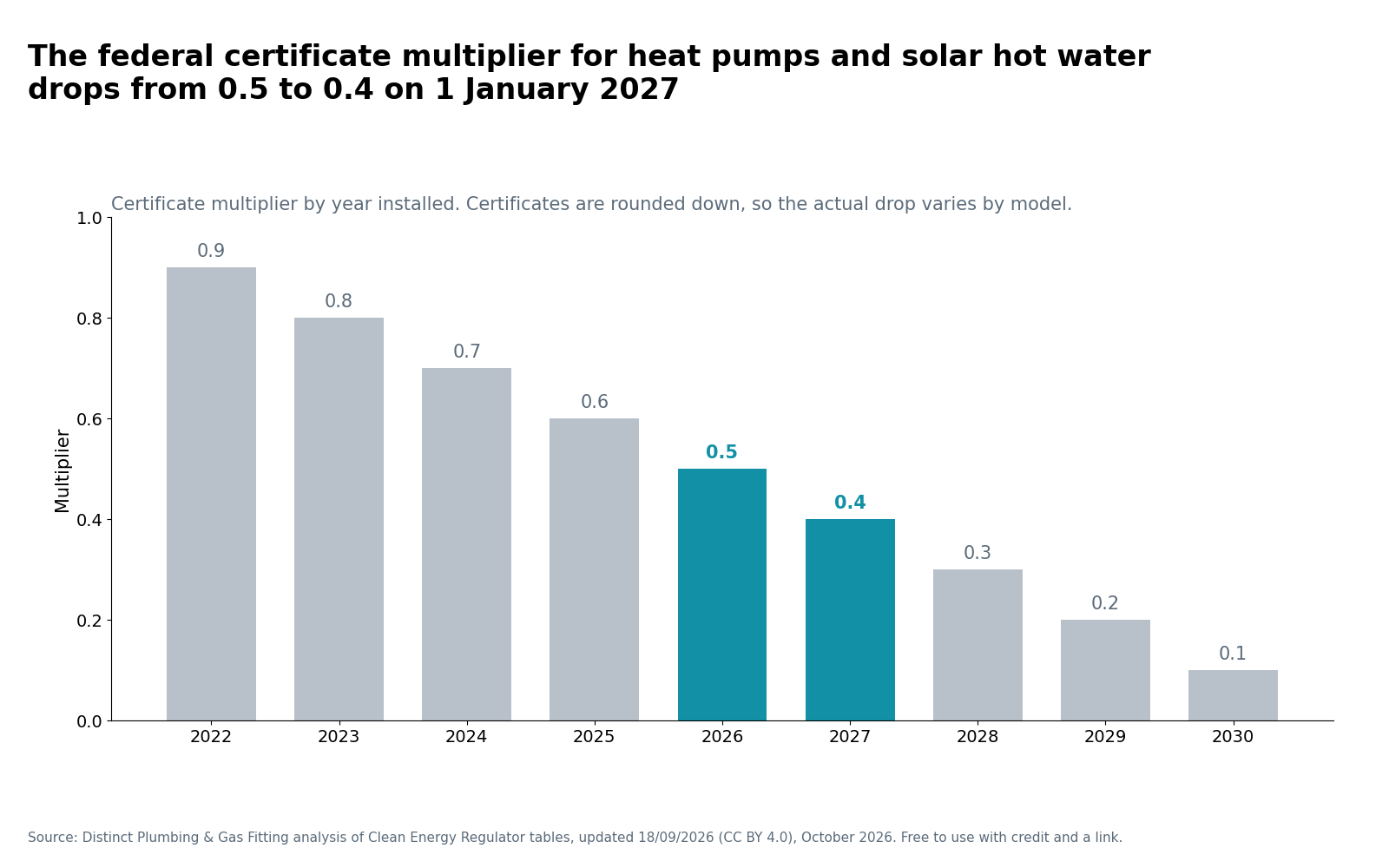
The first date is 31 December. It's the last day to buy a gas hot water system and still get Australian Gas Networks' 2026 rebate.[1] The second is the very next day, 1 January 2027, when fewer federal certificates become available for heat pumps and solar hot water, because the government’s multiplier drops from 0.5 to 0.4.[2]
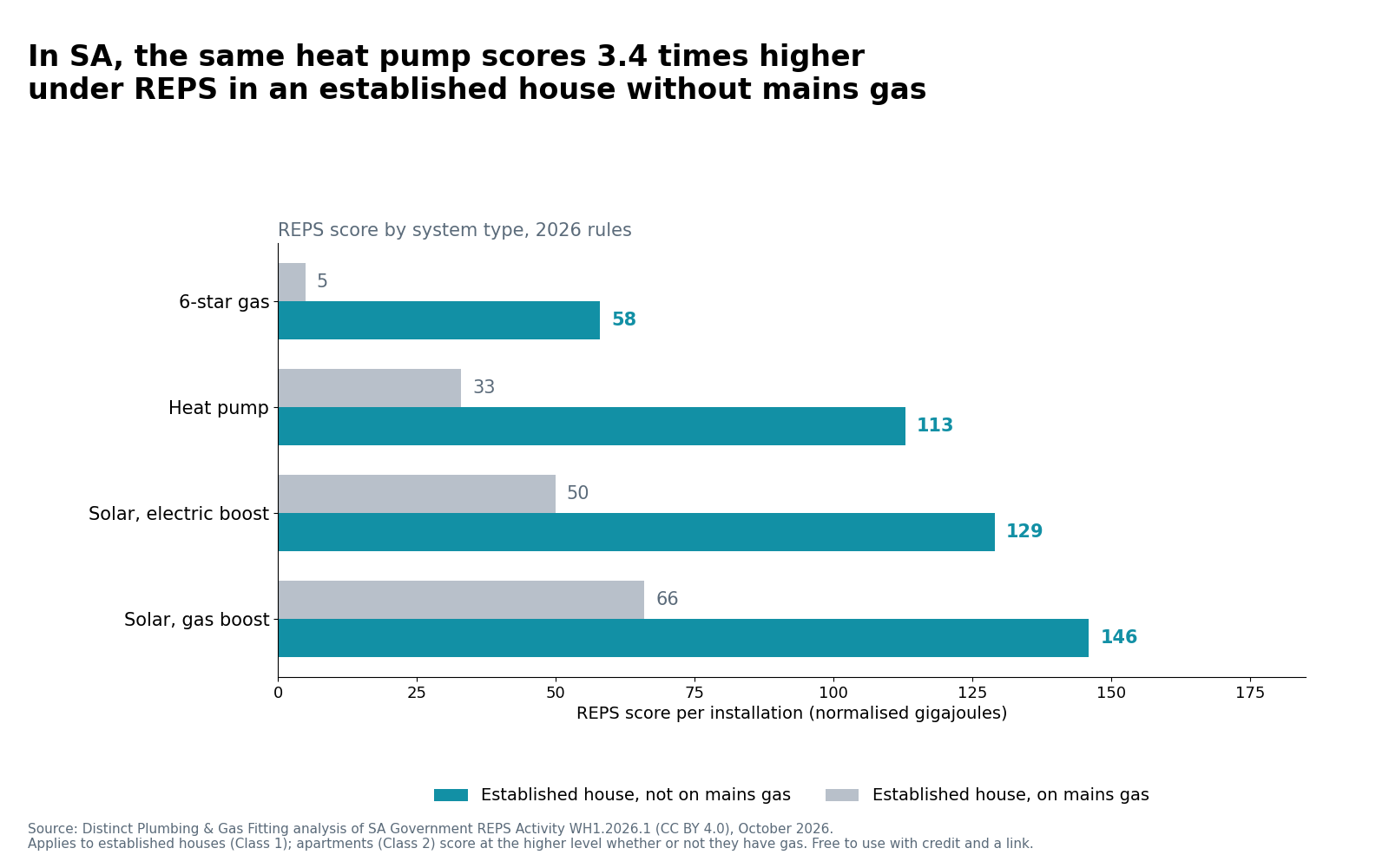
The gas question matters even more. South Australia's own energy-saving scheme, REPS, scores the same heat pump at 113 in an established house without mains gas and just 33 in one with it.[3] That's more than three times the score for exactly the same unit. We've gone through the rules from the people who run each scheme. Below, we set out the hot water rebates in South Australia in plain English, so you can see what applies to your home before you choose.
At a glance
- AGN's gas hot water rebate for 6-star systems or better is $500 for a new load (for example, switching from electric to gas hot water) and $150 for swapping gas for gas, plus a $250 bonus on top for 7-star or gas-boosted solar systems, subject to AGN’s terms. Buy by 31 December 2026, then install and claim by 28 February 2027. Australian Gas Networks
- The multiplier behind the federal discount on heat pumps and solar hot water drops from 0.5 to 0.4 for systems installed from 1 January 2027, so the same system earns fewer certificates. Clean Energy Regulator, our analysis
- Worked example: a heat pump listed on the register at 26 certificates for its postcode zone earns 13 if installed in 2026 and 10 in 2027. That's $120 less at the $40 government clearing house price, which isn't a guaranteed customer discount. Clean Energy Regulator, SA Government, our analysis
- SA's REPS scheme scores a heat pump 3.4 times higher in an established house without mains gas: 113 against 33. Apartments are treated differently. SA Government
- About 23% of the energy used in an average home goes on heating water. SA Government
What each type of system can get in 2026
Which help you can get depends on the type of system and whether your home has mains gas.[1][3][4] Here are the four common efficient options side by side.
| Gas (6-star or better) | Heat pump | Solar, electric boost | Solar, gas boost | |
|---|---|---|---|---|
| AGN gas rebate (home on mains gas, bought by 31/12/2026) | $500 new load (for example, electric to gas), $150 gas for gas; +$250 if 7-star | No (gas appliances only) | No | +$250 bonus on top of the base AGN rebate ($500 or $150), subject to eligibility |
| Federal discount (STCs) | No (conventional gas-only systems) | Yes, if the model is eligible | Yes, if the model is eligible | Yes, if eligible |
| REPS score, established house without mains gas | 58 | 113 | 129 | 146 |
| REPS score, established house with mains gas | 5 | 33 | 50 | 66 |
| Worth a look if | Homes on gas swapping like for like before 31 December | Homes without mains gas; ask whether it suits your off-peak supply | Homes with a north-facing roof that isn't shaded | Homes on gas with a suitable roof |
The short answer: there's no single best system. Your gas connection, your roof and when you buy decide which one gets the most help.
Why mains gas changes the state scheme
REPS is the SA Government's Retailer Energy Productivity Scheme. It sets energy-saving targets for obliged energy retailers, which they meet by offering discounted upgrades.[5] Some REPS upgrades may need a $33 co-payment (including GST), paid once per premises; priority-group households, such as concession card holders, don’t pay it.[8] In the rules, each qualifying upgrade gets a score. The government calls it "normalised REPS gigajoules"; think of it as points toward the retailer's target.[3]
For a new heat pump in an established house (Class 1 under the building code), the score is 113 if the house isn't connected to mains gas and 33 if it is. Every type of system scores higher in a house without mains gas. Apartments (Class 2), new or established, are treated differently: they score at the higher level whether or not they have gas. A water heater put in as part of house building work that needs approval, including any new house, isn’t eligible. Homes without mains gas include those on bottled LPG, and REPS counts LPG systems, but AGN’s rebate is for natural gas only.[3]
The same heat pump scores more than three times higher under SA's REPS scheme in an established house without mains gas.
| System | Established house without mains gas | Established house with mains gas |
|---|---|---|
| 6-star gas | 58 | 5 |
| Heat pump | 113 | 33 |
| Solar, electric boost | 129 | 50 |
| Solar, gas boost | 146 | 66 |
The score isn't a dollar amount, and each retailer sets its own offer. You don't have to be a customer of a retailer to ask for its offer, and different retailers offer different things, so it's worth asking a few, and checking one is available for your installation before you order.[5] The water heater upgrade can only be done once per premises.[8]
Federal certificates drop on 1 January
Eligible heat pump and solar hot water systems earn federal certificates, called STCs. Most people sign them over to an agent, and they may get an upfront discount on the price in return.[6]
How many certificates a system earns depends on when it's installed. Each eligible model has a number on the government register, which depends on your postcode zone. That number is multiplied by a figure that drops every 1 January: 0.5 for systems installed in 2026 and 0.4 in 2027, rounded down.[2] The multiplier is 20% lower. Because of the rounding, the actual drop in certificates varies by model, and the dollar difference depends on the price your installer or agent offers.
| Year installed | Years counted | Multiplier |
|---|---|---|
| 2022 | 9 | 0.9 |
| 2023 | 8 | 0.8 |
| 2024 | 7 | 0.7 |
| 2025 | 6 | 0.6 |
| 2026 | 5 | 0.5 |
| 2027 | 4 | 0.4 |
| 2028 | 3 | 0.3 |
| 2029 | 2 | 0.2 |
| 2030 | 1 | 0.1 |
Here's a worked example for one heat pump. In 2026 a heat pump needs at least 13 certificates in both of the climate zones the REPS rules use (Zones 3 and 4) to qualify for REPS.[3] As a worked example, take a model listed on the register at 26 certificates for its postcode zone: it earns 13 if installed this year and 10 if it goes in next year. Other models differ. At 10, that model would fall below the 2026 REPS minimum of 13, so check REPS eligibility again for a 2027 installation. The government's clearing house has a fixed price of $40 each (excluding GST), so at that price it's $120 less.[6] That isn't a guaranteed customer discount. The discount you're actually offered depends on the agent, so ask for each incentive and the final price to be itemised on your quote.
AGN's gas rebates: buy by 31 December
Australian Gas Networks is the only gas distributor in South Australia, so if your home is on mains gas, you're on its network. Its 2026 hot water rebate is for existing homes, not new builds.[1] A natural gas system rated 6 stars or more gets $500 if it adds gas hot water where there wasn't any before (AGN calls this a new load, for example switching from electric to gas) and $150 if it replaces an existing gas water heater. There's an extra $250 on top of that for gas-boosted solar or 7-star systems, subject to AGN's terms.[1]
You need to buy it by 31 December 2026. Installation and the claim both have to be done by 28 February 2027. You can claim through a registered rebate supplier, who passes the rebate on as a discount or a refund. Or you can claim it yourself on AGN's cashback website, using your gas compliance certificate and invoice.[1] A registered rebate supplier can look after the claim for you, so ask about it when you get a quote for gas hot water with the AGN rebate. If your home is connecting to gas for the very first time, AGN also has a Connection Bonus: $250 for one gas appliance, $500 for two and $750 for three or more, so a hot water system on its own counts as one. You have 12 months from when the gas meter is installed to install the appliances and claim it.[1]
You might not be able to swap like for like
South Australia has rules for replacement water heaters, not just new ones. For most homes, the new system has to be a low-emission one: high-efficiency gas, solar or an electric heat pump.[4] Only a licensed or registered plumber can install a water heater, and your plumber has to give you a Certificate of Compliance for the work.[4] If the new system stores hot water, it has to be kept at 60°C or more.[7]
It's worth getting right. The SA Government puts water heating at about 23% of the energy used in an average home.[7]
What to do before 31 December
- Check whether your home is on mains gas. In an established house it changes the REPS score for every system, and AGN's rebate is for homes connected or connecting to its network.
- Staying with gas? Buy by 31 December. AGN's rebate goes on the purchase date. Installation and the claim must both be done by 28 February 2027.
- Going heat pump or solar? Check the timing. Installed by 31 December, it uses the 2026 multiplier; from 2027 the same system earns fewer federal certificates. Compare full quotes before you rush.
- Ask a few energy retailers whether they have a REPS offer for your installation, before you order. You don't need to be their customer, and offers differ.
- Ask for each incentive and the final price to be itemised on your quote. Then compare quotes for the same model and installation.
- Keep your invoice and compliance certificate. AGN asks for both if you claim the rebate yourself.
If you're planning a hot water replacement or weighing up heat pump and solar options, give us a call on (08) 8482 1744. We'll help you check which of these could apply to your home, and show any incentives in your quote, before you commit.
Frequently asked questions
What is the maximum rebate available for heat pump hot water systems in South Australia?
There isn't one set figure, because the help comes from separate schemes and depends on the model, your postcode zone and the offers available. In 2026 a heat pump needs at least 13 federal certificates, in both Zones 3 and 4, to qualify for REPS. At the government clearing house price of $40 each (excluding GST), 13 certificates would be worth $520. That's an illustration, not a maximum or a typical discount, because agents set their own prices. Some energy retailers also make REPS offers, and they differ, so ask for an itemised quote for the model you're considering.[2][3][6]
Is it worth getting a heat pump hot water system?
It depends on your home and how much hot water you use, and mains gas makes a big difference to the help available. The state's REPS scheme scores a heat pump at 113 in an established house without mains gas and 33 in one with it, and eligible heat pumps also earn federal certificates. The SA Government also notes a heat pump can be connected to the off-peak electricity meter.[3][7]
Do I have to be with a particular energy retailer to get a REPS offer?
No. The SA Government says you don't have to be a retailer's customer to access its energy saving offers, and different retailers offer different things, so it's worth asking a few, and checking one is available for your installation before you order.[5]
Can I still get the AGN gas rebate if my new system goes in after Christmas?
Yes, if the system and your home qualify and you bought it by 31 December 2026. It then has to be installed, and the claim lodged, by 28 February 2027.[1]
Does a new gas hot water system get the federal discount?
Not a conventional gas-only system. The federal certificates are for eligible solar and heat pump water heaters, and that includes eligible gas-boosted solar systems. A gas-only system rated 6 stars or more can get AGN's rebate instead, if your home is on AGN's gas network and you buy by 31 December 2026.[4][1]
How we worked out the numbers
Where the figures come from: AGN's 2026 rebate terms; the SA Government's REPS rules for water heaters (Activity WH1.2026.1); the Clean Energy Regulator's certificate tables (updated 18/09/2026) and clearing house price; ESCOSA's REPS guidance.
Our sums: REPS heat pump score 113 ÷ 33 = 3.4. Multiplier drop: 0.5 to 0.4 is 20% lower; with rounding, the drop in certificates varies by model. Worked example: a heat pump on the register at 26 or 27 certificates for its postcode zone earns 13 in 2026 (x 0.5, rounded down) and 10 in 2027 (x 0.4, rounded down); 3 fewer certificates x $40 = $120.
What we left out: REPS scores aren't dollar amounts, because retailers set their own offers. Certificate numbers vary by model and postcode zone. The $40 clearing house price isn't the discount you'll be offered, which depends on the agent. We haven't estimated yearly running costs for each system, because how much hot water a home uses varies too much. We haven't included council rebates, because we couldn't confirm any from a council.
Figures checked on 17/10/2026, 21/10/2026 and 28/10/2026 against the published pages of each scheme. 8 sources are listed below.
This is general information, not financial advice. Rebate terms can change, so check the current terms with each scheme before you buy. Includes material from the Clean Energy Regulator and the Government of South Australia, used under a Creative Commons Attribution 4.0 licence; neither has reviewed or endorsed this article.
Use this data
Free to use with credit and a link to this page. Download the figures: REPS scores (CSV), certificate multipliers by year (CSV), heat pump example (CSV).
Media enquiries: Distinct Plumbing & Gas Fitting, 104 Brown Terrace, Salisbury SA 5108, (08) 8482 1744.
Sources
- Australian Gas Networks, Gas Rebates South Australia: 2026 Appliance Rebate Offers, 2026. https://www.australiangasnetworks.com.au/rebates-SA. Table 1 and FAQs.
- Clean Energy Regulator, Calculate small-scale technology certificate entitlements, updated 18/09/2026. https://cer.gov.au/schemes/renewable-energy-target/small-scale-renewable-energy-scheme/small-scale-technology-certificates/calculate-small-scale-technology-certificate-entitlements. Deeming period and multiplication factor tables.
- Government of South Australia, Department for Energy and Mining, Retailer Energy Productivity Scheme, Activity WH1: Replace or Upgrade Water Heater (WH1.2026.1), 2026. https://energymining.sa.gov.au/__data/assets/pdf_file/0005/1375763/Replace-or-Upgrade-Water-Heater-WH1.pdf. Sections 3, 4 and 6.
- Government of South Australia, Water heater requirements, updated 02/07/2024. https://www.sa.gov.au/topics/energy-and-environment/energy-efficient-home-design/water-heater-requirements.
- Government of South Australia, Energy discounts and offers from retailers, updated 14/12/2023. https://www.sa.gov.au/topics/energy-and-environment/using-saving-energy/retailer-energy-productivity-scheme.
- Clean Energy Regulator, Renewable energy certificates, updated 13/10/2025. https://cer.gov.au/markets/renewable-energy-certificates. STC markets.
- Government of South Australia, Save water and energy in the bathroom, updated 01/05/2024. https://www.sa.gov.au/topics/energy-and-environment/using-saving-energy/using-and-buying-appliances/water-heaters.
- Essential Services Commission of South Australia, REPS FAQs for households and businesses, 2026. https://escosa.sa.gov.au/industry/reps/faqs/households-businesses. Co-payment and priority groups; ESCOSA REPS bulletins for once per premises.

Matthew Johnson
Matthew Johnson is the Owner, Director, and Master Plumber at Distinct Plumbing & Gas Fitting, bringing 19 years of hands-on plumbing experience to residential and commercial clients across Adelaide. He founded the business nine years ago with a clear mission: to deliver reliable, high-quality plumbing solutions backed by integrity and exceptional service.
Specialising in residential and maintenance plumbing, Matthew and his team handle everything from emergency repairs and pipe installations to hot water system upgrades, blocked drains, and advanced drain relining. Known for his practical expertise and problem-solving approach, Matthew ensures every project is completed to the highest standard, right the first time.